
Follow us:


On one end, you have the polished resort strip: poolside cocktails, all-inclusive wristbands, and beach clubs pumping house music at 11am. On the other, you have the raw Atlantic edge, where the cliffs are higher, the crowds are thinner, and the only soundtrack is the wind and the ocean doing their thing.
Stretching 150 kilometres across Portugal’s southern coast, the Algarve packs in golden cliffs, sea caves you’ve definitely seen on Instagram, world-class surf, over 330 days of sunshine a year, and food that punches well above its price tag. It’s been voted Europe’s best beach destination more times than anyone can count, and it draws millions of visitors from the UK, Germany, the Netherlands, and the US every year. Most of them never make it past Albufeira.
This guide is here to fix that. We’ll cover the best beaches (including the ones that don’t show up on every top-ten list), how to actually get here without overpaying, where to stay, what to do, and which part of the Algarve fits the kind of trip you’re actually looking for.
The Best Beaches in the Algarve
Algarve beaches are globally famous, and the variety is genuinely remarkable.
Here’s a geographic overview from west to east:
Western Algarve Beaches
Praia do Amado - One of Europe’s premier surf beaches. Broad, wild, backed by dunes, and home to a respected surf school. No crowds, no sunbeds, no nonsense. Located between Aljezur and Sagres.
Praia de Beliche - A hidden gem tucked under dramatic cliffs near Cabo de Sao Vicente. Accessible via a steep path. Worth every step.
Praia de Dona Ana (Lagos) - Gorgeous golden cliffs, calm clear water, and easy access from Lagos town. One of the most photographed beaches in Portugal.
Meia Praia (Lagos) - A 4km stretch of sandy beach, calm waters, and water sports facilities. The best long-stay beach near Lagos town.
Explore all 18 beaches near Sagres → LINK
Central Algarve Beaches (the iconic ones)
Ponta da Piedade - Technically not a beach but the defining image of the Algarve. A labyrinth of sea arches, caves, and golden grottos accessible by boat from Lagos. Non-negotiable on any Algarve itinerary.
Praia da Marinha - Consistently rated among Europe's most beautiful beaches. Small, sheltered, and surrounded by extraordinary rock formations near Lagoa.
Benagil Cave (Algar de Benagil) — The single most iconic image of the Algarve: a cathedral-like sea cave with a circular skylight that floods the interior with light and a small beach inside. It is only accessible by water (kayak, paddleboard, or boat tour from Benagil beach). Never attempt to swim in from the beach; the currents and boat traffic are dangerous. Boat tours from Lagos take about 90 minutes and typically combine Benagil with other caves along the coast.
Praia de Carvoeiro - A classic Algarve beach nestled in a village of the same name. Turquoise water, colourful boats, excellent restaurants nearby.
Praia da Falesia - Regularly ranked among the best beaches in the world (TripAdvisor Travellers’ Choice #1 in 2024, named best beach in Europe by Time Out in 2026). Over 6 kilometres of golden sand between Olhos de Agua and Vilamoura, backed by towering red-and-orange clay cliffs up to 40 metres high. The western section near Olhos de Agua has the most dramatic cliff colours. The wider eastern end near Vilamoura is better for families. Lifeguards operate in summer, Blue Flag certified.
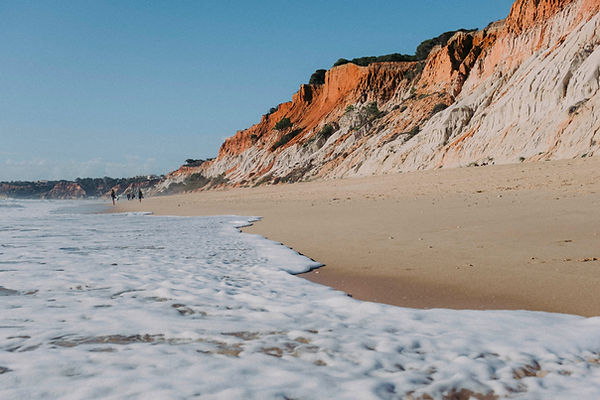
Praia da Rocha (Portimao) - A broad, bustling beach at the mouth of the Arade River, flanked by golden cliffs and packed with bars, restaurants, and water sports operators. One of the Algarve's most popular beach resort areas.
Eastern Algarve Beaches
Ilha de Faro (Faro Island) — Part of the Ria Formosa barrier island system. Long, flat stretches of golden sand with calm lagoon water on one side and open Atlantic on the other. Accessible by car or ferry from Faro’s old town.
Local tip: Combine a morning at the beach with lunch at one of the wooden-deck seafood restaurants on the lagoon side. Fresh clams and oysters from the Ria Formosa served right where they’re harvested.
Ilha de Tavira (Tavira Island) — Reached by ferry from Tavira or small train from Barril beach car park. Endless sand, warmer water than the western Algarve. Praia do Barril is famous for its "anchor cemetery", dozens of rusting anchors from the old tuna fishing industry.
Local tip: Take the ferry to the eastern end. Walk 15 minutes from the landing and you’ll have the beach virtually to yourself.
Praia Verde — Near the Spanish border, backed by pine forest, warm shallow water, almost no development. If you want a beach that still feels like a secret, head east.

Top Things to Do
Nature and Coastal Attractions
Ponta da Piedade (Lagos) — Towering sea stacks, grottoes, and arches carved from golden limestone. Explore from above on the clifftop walkway (free) or from the water by boat, kayak, or paddleboard. Boat trips from Lagos marina take about an hour and cost around 20€.
Benagil Cave - The Benagil Cave (Algar de Benagil) is the single most iconic image of the Algarve: a cathedral-like sea cave with a circular skylight that floods the interior with light and a small beach inside. It is only accessible by water (kayak, paddleboard, or boat tour from Benagil beach). Never attempt to swim in from the beach; the currents and boat traffic are dangerous. Boat tours from Lagos take about 90 minutes and typically combine Benagil with other caves along the coast. From Sagres, book a full-day tour or drive to Lagos (30 min) for the boat departure.
Seven Hanging Valleys Trail (Percurso dos Sete Vales Suspensos) — Widely considered one of the best coastal walks in Europe. 5.7 km from Praia da Marinha to Praia de Vale Centeanes, passing dramatic cliff formations, hidden coves, and the Benagil Cave viewed from above. Allow 2 to 3 hours one way. Start at the Vale Centeanes end to avoid the crowds.
Alvor Boardwalk (Passadicos de Alvor) — A wooden boardwalk through the Alvor estuary, salt marshes, and dunes. Flat and accessible, about 3 km each way. Spot flamingos, herons, and wading birds. Perfect morning activity for families.
Sagres Fortress and Cape St. Vincent - The Fortaleza de Sagres, built in the 15th century, is the Algarve’s most visited monument and a European Heritage site. Tickets cost 10€ and are only sold at the gate. There are no official online tickets at the moment; avoid third-party resellers as they may not be accepted at the entrance. Then drive 6 km west to Cabo de Sao Vicente, mainland Europe's southwesternmost point. The lighthouse is currently closed to visits, but the dramatic cliffs, sunset views and surrounding headland remain free and open. Stay for sunset. It is unforgettable.
Surfing
The Western Algarve is one of Europe’s finest surfing destinations. The Sagres headland offers a unique two-coast advantage: when the west coast is too big or too windy, the south coast opens up with clean, surfable waves. Surf schools operate year-round with lessons from 55€ per person.
Surfing in Sagres: Complete Surf Guide → LINK
Hiking
The western Algarve coast offers some of Europe’s most spectacular coastal walking. The [Fishermen’s Trail] follows the clifftops above empty beaches. Individual stages can be walked as day hikes. The trails near Sagres are among the most dramatic.
Boat Tours
The single best way to experience the Algarve’s legendary coastline is from the water. Boat tours take you through sea arches, into hidden grottos, and right up to the Benagil Cave. Tours range from 45-minute express trips to half-day adventures. Most operate April through October.
Dolphin Watching
Dolphin watching trips depart regularly from Sagres, Lagos, and Portimao. Common and bottlenose dolphins are spotted year-round, particularly from spring through autumn.
Golf
The Algarve has over 40 golf courses, many championship-standard. Quinta do Lago and Vale do Lobo near Faro are among the best in Europe. Green fees range from around 50€ at smaller courses to over 200€ at premium resorts. The mild winter climate makes the Algarve one of the few European golf destinations that works 12 months a year.
Skydiving
For the ultimate perspective on that famous Algarve coastline, nothing beats a tandem skydive: freefalling over golden cliffs and turquoise Atlantic water at 200 km/h. Sagres and the western coast offer some of the most spectacular skydive views in Europe.
Cycling
The Algarve’s interior, the Serra de Monchique and the Barrocal, offers excellent cycling terrain. The Via Algarviana long-distance cycling route crosses the region east to west.
Theme Parks and Family Attractions
Zoomarine Algarve — The biggest family attraction. Marine life park, water park, and aquarium near Albufeira. Open spring through early autumn.
Slide & Splash (Lagoa) — Biggest water park in the Algarve. Over 25 slides and attractions.
AquaShow Park (Quarteira) — Water park and theme park hybrid. The only roller coaster in the Algarve. Best for families with children over 6.
Culture and Heritage
Faro Old Town (Cidade Velha) - Enter through the monumental Arco da Vila, built on Roman foundations. 13th-century cathedral with rooftop views over the Ria Formosa, Municipal Museum, and the bone chapel (Capela dos Ossos) inside the Igreja do Carmo.
Local tip: Climb to the top of the cathedral bell tower. The view across the lagoon, rooftops, and out to the barrier islands is worth the narrow staircase.
Mercado de Loule — One of the best traditional markets in southern Portugal. Neo-Moorish building with stalls selling fresh fish, local cheeses, cured meats, and handmade crafts. Saturday morning is the most atmospheric.
Mina de Sal-Gema de Loule (Loule Salt Mine) - A former salt mine beneath Loule converted into a museum and event space. Underground galleries, geological exhibits, and occasional concerts.
Palacio de Estoi — A pink rococo palace, now a luxury pousada. Gardens open to the public with tile panels, fountains, and classical statuary. Nearby Roman ruins (Milreu) with mosaic floors.
Silves Castle — The Algarve’s medieval Moorish capital. The red-stone castle dominates the town from a hilltop. Combine with local orange and almond orchards.


Best Hotels in the Algarve
Luxury & Five-Star
Vila Vita Parc (Porches/Lagoa) — Consistently rated among the best hotels in Portugal. Clifftop setting, two Michelin-starred restaurants, world-class spa, direct beach access. About 20 minutes from Carvoeiro, 45 from Faro Airport.
Conrad Algarve (Quinta do Lago) — Modern five-star among the golf courses of Quinta do Lago. Michelin-starred dining at Gusto, infinity pool, spa. 25 minutes from Faro Airport. Ideal for couples and golf travellers.
Pine Cliffs Hotel (Praia da Falesia) — A Luxury Collection resort above one of the best beaches in Europe. Tennis academy, kids’ clubs, golf course, nearly a dozen restaurants on-site.
Boutique & Design
Memmo Baleeira (Sagres) — A striking whitewashed design hotel on the Sagres peninsula with its own surf centre. Wild beaches, cliffs, and Atlantic light rather than a polished resort bubble. Genuine Sagres character.
Tivoli Carvoeiro — Recently refurbished, spectacularly positioned on a cliff above the sea. Walking distance to Carvoeiro village, Seven Hanging Valleys trail starts at the door.
Mid-Range & Value
EPIC SANA Algarve (Praia da Falesia) — Sleek five-star with direct Falesia Beach access, adults-only pool, kids’ club, four restaurants. One of the best price-to-quality ratios in the Algarve.
Martinhal Sagres Beach Resort — Purpose-built for families, with dedicated kids’ clubs, hotel rooms to villas, unbeatable location on the Sagres coastline. The best family hotel in the Western Algarve.
By Region
Lagos and Western Algarve — Best base for active travellers, surfers, and those wanting to explore [Sagres] and Ponta da Piedade. Good range of boutique hotels, hostels, and surf camps.
Albufeira and Central Algarve — Best for families and classic beach resort experience. Widest range of all-inclusive options. Closest to Praia da Falesia.
Vilamoura, Vale do Lobo and Quinta do Lago — Best for golf, luxury, and high-end resort experiences. The "Golden Triangle" of the Algarve.
Faro and Eastern Algarve — Best for culture, authenticity, and easy airport access.
Sagres — Best for surfers, hikers, and anyone seeking a genuinely untouched experience at the edge of Europe.
Find Hotels in Sagres → LINK
Best Time to Visit the Algarve
The Algarve is a year-round destination, but the experience varies significantly by month. Here's the honest breakdown:
Algarve Weather by Month
April and May — Sweet spot for nature lovers. Wildflowers blanket the cliffs. 18 to 24°C, sea refreshingly cool, no crowds. Perfect for hiking and exploring Cabo de Sao Vicente without jostling for space. The Festival dos Descobrimentos in Lagos brings Age of Discoveries history to life with parades and medieval markets.
June and July — Peak season begins. Long days, guaranteed sun, sea temperatures climbing to 20°C. July sees Faro, Lagos, and Albufeira at their busiest. Book early. The Western Algarve stays noticeably quieter. Festival MED transforms Loule’s historic centre into a celebration of world music and international food.
August — High season. Hottest month (30°C+), fully booked resorts, elevated prices. Still brilliant for beach life, but go west if you value space. Portimao’s Festival da Sardinha takes over the riverside. The Silves Medieval Fair transforms the old Moorish capital into a medieval spectacle.
September and October — The insider’s favourite. Sea temperatures peak in September (22°C), crowds thin, prices drop, and the light turns golden. October is still warm enough to swim. The Sagres Birdwatching Festival draws thousands of birds and birders to Cape St. Vincent.
November and December — Mild (15 to 18°C), crowd-free, ideal for hiking, birdwatching, and slow travel. Sagres in November is spectacular: storms roll in off the Atlantic, migratory birds fill the sky, and you’ll have the beaches almost to yourself.
January and February — Quiet season. Not a beach holiday, but surfers love February swells. Almond trees bloom across the region. The Volta ao Algarve cycling race (five stages, mid-February) brings world-class road racing. Sagres maintains a loyal community of long-stay travellers who know what they’re doing.
How to Get to the Algarve
By Air
Faro Airport (FAO) is the main gateway, with direct flights from most major European cities. UK: approximately 2h30. Germany and Netherlands: around 3 hours. Direct flights from North America in summer. Search on Google Flights, Skyscanner, EasyJet, Ryanair, or TAP Air Portugal. April, May, October, and November offer the best value.
Pro tip: Flying into Lisbon and renting a car is sometimes cheaper. The drive south along the A2 takes about 2.5 hours through the Alentejo.
From Lisbon
By train: Express trains (Alfa Pendular and Intercidades) from Lisbon Oriente to Faro, five times daily, fastest in about 3 hours. From 22€ to 24€ second class. Connect at Tunes or Faro for Lagos, Portimao, Albufeira, and Tavira.
By bus: Rede Expressos and FlixBus from Lisbon (Sete Rios and Oriente) to Lagos, Albufeira, Faro, and Portimao. FlixBus fares from 4€ to 8€ if booked early. One direct bus per day from Lisbon to Sagres (about 4 hours).
By car: A2 motorway from Lisbon, roughly 2.5 hours. Tolls around 23€ one way. Car rental strongly recommended for the western Algarve.
From Porto
By train: Alfa Pendular from Porto Campanha to Faro, twice daily, about 6 hours. From around 57€ second class.
By bus: FlixBus and Rede Expressos, about 7 to 7.5 hours. From around 19€.
By car: About 520 km via A1 and A2. 5+ hours plus tolls. Consider breaking the trip in Lisbon or the Alentejo.
From Spain
The eastern Algarve is close to the Spanish border. Buses connect Seville to Faro in about 3 hours. The A22 motorway runs along the entire Algarve coast and connects to the Spanish motorway network at Vila Real de Santo Antonio.
Getting Around the Algarve
Rent a car. It’s the single best thing you can do to unlock the Algarve properly. Public transport reaches the main towns but misses the best beaches, especially in the west. The regional train connects Faro, Loule, Albufeira, Portimao, and Lagos. Uber and Bolt operate throughout the region.
Food and Drink
The Algarve is one of the most underrated food regions in Southern Europe. Fresh Atlantic seafood, locally grown citrus, almonds, figs, and carob form the backbone of the cuisine.
What to eat: Grilled fish (fresh sardines in summer, sea bream, sea bass), cataplana (copper-pot seafood stew that originated in the Algarve), percebes (goose barnacles), arroz de marisco (shellfish rice), and pasteis de nata. For dessert, almond and fig sweets are an Algarve speciality.
What to drink: Vinho verde (young, slightly sparkling white, perfect in summer), local wines from the Lagos and Portimao DOC region, a cold Super Bock or Sagres beer. Medronho (strawberry tree spirit) is the Algarve’s traditional liquor, extremely strong and homemade in many villages.
Local tip: Skip the tourist-menu restaurants on the main strips. The best seafood costs half the price at family-run places one street back. Ask your accommodation host.

Festivals and Events
Sagres Birdwatching Festival (October) — One of Europe’s top birdwatching events. Cape St. Vincent is a major migration corridor.
Festa da Mae Soberana (Loule, Easter) — One of Portugal’s most extraordinary religious processions.
Festival dos Descobrimentos (Lagos, April/May) — Celebrating Lagos’s role in the Age of Discoveries with parades, medieval markets, and street performances.
Festival MED (Loule, late June) — World music, street art, international food in the medieval streets of Loule.
Afro Nation (Portimao area, July) — Massive beach festival covering hip hop, R&B, dancehall, and afrobeats across three days.
Festival da Sardinha (Portimao, August) — Grilled sardines, cold beer, live music every evening on the riverside.
Festival do Marisco (Olhao, August) — Huge seafood festival on the Olhao waterfront, celebrating the Ria Formosa lagoon.
Silves Medieval Fair (Silves, August) — Jousting, banquets, historical recreations in the Moorish castle town.
New Year at Cape St. Vincent (December 31) — Watch the last sunset of the year at the southwestern tip of Europe.
Local patron saint festas pop up in villages throughout the summer with fireworks, folk dancing, and grilled food. Ask around when you arrive.
Sagres: The Wild Side of the Algarve
If this guide has one message, it is this: go west. The further you travel from Faro Airport, the wilder, quieter, and more authentic the Algarve becomes. And at the very end of the road, on a windswept headland at the southwestern tip of Europe, sits Sagres.
The end of the road, in the best possible sense. Sagres sits on a windswept headland at the southwestern tip of Europe, surrounded on three sides by the Atlantic. This is not a resort town. World-class surf, dramatic cliffs, the 15th-century Sagres Fortress (10€, sold only at the gate; there are no official online tickets, so avoid third-party resellers as they may not be accepted at the entrance), and Cape St. Vincent, where the ancient world once believed the earth ended. The western Algarve at its most raw and authentic.
Algarve Travel Tips
-
Book accommodation early for July and August. The best properties sell out months in advance, especially in the Western Algarve.
-
Go west. The further west you go, the wilder, quieter, and more authentic it gets. [Sagres] and the Costa Vicentina are a world apart from the resort strip.
-
Respect the ocean. Atlantic waves are powerful. Red flags mean no swimming. Many sea caves are only safely accessible by guided boat tour.
-
Learn a few words of Portuguese. Locals genuinely appreciate it. In the Western Algarve, not everyone speaks English.
-
Eat where the locals eat. Skip the tourist-menu restaurants. The best seafood costs half the price one street back.
Frequently Asked Questions
Is the Algarve worth visiting?
Without question. The combination of climate, coastline, food, and relative affordability makes it one of Europe’s most compelling destinations. The key is knowing which part suits you best.
How many days do you need in the Algarve?
A minimum of 5 to 7 days to cover the highlights properly. Two weeks lets you explore at a comfortable pace, include day trips, and discover the quieter corners that most visitors miss.
Is the Algarve expensive?
Compared to the UK, France, or Scandinavia, no. Compared to other parts of Portugal, somewhat more in peak season. Sagres and the Western Algarve remain noticeably more affordable than Albufeira or Vilamoura.
What is the best beach in the Algarve?
It depends on what you’re after. For drama and scenery: Praia do Beliche or Praia da Marinha. For surf: Praia do Amado. For calm, clear water: Praia de Dona Ana. For sheer scale: Praia da Falesia. For something genuinely wild: head to the Western Algarve coast near Sagres.
What is the best hotel in the Algarve?
For luxury: Vila Vita Parc and Conrad Algarve. For design and location: Memmo Baleeira in Sagres. For families: Martinhal Sagres or Pine Cliffs Hotel. It depends on your style, budget, and preferred coastline.
Is Sagres worth visiting?
Absolutely, and for many travellers it becomes the highlight of the entire trip. Read our full guide to Sagres.
Can you visit Benagil Cave?
Yes, but only by water: kayak, paddleboard, or boat tour. Never attempt to swim in from the beach. The currents and boat traffic are dangerous.
Book a Benagil Cave Tour → LINK
How do I get from Lisbon to the Algarve?
Express trains from Lisbon Oriente to Faro in about 3 hours (from 22€). Direct buses (Rede Expressos, FlixBus) at even lower prices. Driving takes roughly 2.5 hours via the A2. For the Western Algarve and [Sagres], a car is the most practical option.
What are the best theme parks in the Algarve?
Zoomarine (marine life and water park) is the most complete. Slide & Splash in Lagoa is the biggest water park. AquaShow near Quarteira has the only roller coaster. All three are ideal for families, open spring through early autumn.
Is the Seven Hanging Valleys Trail worth it?
Absolutely. 5.7 km from Praia da Marinha to Vale Centeanes. Dramatic cliffs, sea arches, hidden coves. Allow 2 to 3 hours one way. Best in the morning.
How do I get to Faro Island and Tavira Island?
Faro Island: by car over a bridge or ferry from Faro’s old town. Tavira Island: ferry from Tavira or small train from Barril car park. Both are Ria Formosa natural park with long, flat beaches.
What is there to do in Faro besides the airport?
More than you’d expect. Walled old town with 13th-century cathedral and rooftop views, municipal museum, cobbled streets. Faro Island beach is a short drive or ferry away. The Ria Formosa offers boat tours, birdwatching, and excellent seafood.